Writing Notes

If I ever became famous and someone asked me, "What's your secret? How do you do it?" I think my answer would be: "I'm really good at taking notes."
I don't know when this started. Maybe in high school? But in college, it really took over. I got my first laptop—a Powerbook G4, back when getting a Mac was learning a new language—and took it to every class, to aggressively transcribe every word of every lecture. I took the court-stenographer approach to annotation.
And it wasn't just in class: I was the "executive secretary" for my fraternity, our class council, and class trustees. Which meant that I got to be part of the executive committee, but had very limited responsibility, outside of... well, taking very comprehensive notes and sending them out to everyone.
I think I subconsciously developed this approach to manage my own adhd. Even when I'm listening to something really interesting, it's easy for my mind to wander, and the effort of typing it out and structuring the text keeps me focused. I often found, with the class notes, that I didn't really need to review them later... but the act of capturing them helped burn them into my brain. Back in elementary school, I would often get in trouble for talking in class because I'd hear something and couldn't resist the urge to make an aside comment to a friend. Being the official annotator meant that I had an outlet to make my comments on the page, instead of out loud.
All of these note types were recording external information and distilling and organizing it. Over the last few years, I've added exhaustive call notes to this habit—it's not unusual for me to have 1500 words in a note after a catch-up call with a friend. I have a Notion database with my notes on articles and books and poems I've read (along with the occasional podcast or youtube video), which has stacked up... checks notes... 911 entries in the last 4 years. Plus, there's a journaling app I use with different notebooks for different purposes: Reviews of any novel I read or movie I watch. Quick descriptions of any new people I meet. Notes on sermons and courses and webinars.
All of this is a borderline compulsive effort to capture and catalog things that I interact with. But a new habit that I've developed in the last few years shifts the orientation a bit: Almost every day, I add notes into a "quick capture" list, which are mostly reflections on what I'm thinking.
Sometimes this is a great quote I've heard or a resource I don't want to forget. But it's mostly just writing down ideas or questions, as they come to me.
This practice has been an essential part, for me, of establishing a personal writing habit.
And after reading all this, you can obviously tell I'm a bit biased... but I think notes are the center of creativity.
Notes are everywhere
The more I've thought about this, the more I've realized how prevalent the term is:
- Music notes: The atomic units of auditory art.
- Flavor notes: The subtle hints that connaisseurs detect in culinary art.
- Giving notes: The feedback loop for any performer.
So, what's going on?
The core mechanism behind notes is noticing. Art of any kind requires attention, first. And good writing, in particular, always comes back to being observant. Seeing what is in front of you or around you, and considering the specific details. This looks different in functional vs. expressive writing: The practical writer is noticing all of the external details and the needs of the audience and the outside context. The artistic writer has to learn to notice the internal details: How did that feel? What do I care about? What is interesting or surprising to me?
Learning to pay attention is the first step to good writing.
Inputs and Outputs
A lot of writing advice tends to focus on your outputs—the style, the length, the structure. But all of that is downstream of your inputs: What are you reading? What are you looking at? What are you thinking about?
The clearest example of this for me is my 1 newsletter. Every week, I reflect on what I've read and "triple distill" it down into a short letter that takes ≤1 minute to read: first, choosing the best thing I've read in the previous week. Then, identifying the clearest insight from that piece. And finally, boiling it down to a kernel that can fit into 60-seconds-worth of written words.
I love writing it, and what makes it possible is the really aggressive annotation system I mentioned toward the top. Kind of the whole point of the practice is that I don't remember all of the good things I've engaged with. If I didn't capture my thoughts or highlight my favorite passages, I wouldn't be able to recall them enough to write about them 3-4 days later, much less a year or more in the future.
And all of that distillation only works because I'm constantly seeking high-quality inputs, at the top end of the funnel.
First comes the noticing
I've mentioned this to every client for my editing work, and in any conversation I'm in that mentions "writer's block." Because there are many other reasons I struggle to write, but facing down a blank page isn't one of them.
This is because every time I sit down to start typing, I have an enormous backlog of concepts and ideas, waiting to be written out. In fact, I'll often start with a few sentences or even a couple paragraphs that came to me in a flurry, while I was doing something else. I noticed them in my head and wrote them down, and that's generally enough to launch me into a new essay or post.
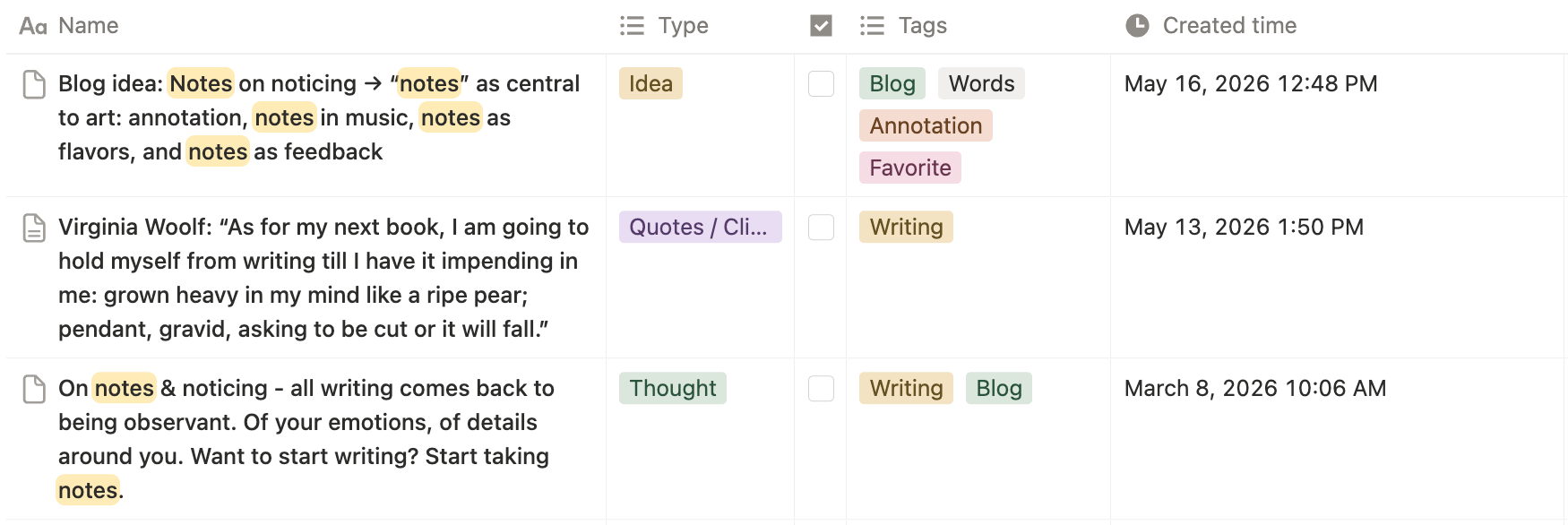
It's painful to sit down and try to write something from scratch, to squeeze out inspiration on command. But that approach is starting too late.
It's like the old saying, "Dig your well before you're thirsty." Don't try to start writing before you know what you want to write about.
Start by noticing. If you want to write... take notes.