Better messy than sloppy.

If you want to write more and you're considering using AI, here's my #1 advice:
Better messy than sloppy.
Meaning: I'd rather see your unstructured, unpolished, unedited writing than clean, sterile, generic words generated by an LLM (which people call “slop”).
If you feel like you can't share your writing unless it's polished and finely tuned, like the whole Internet is waiting to mark up your draft with red ink—I get it. I know how that feels. But it's not true.
[Note: There are lots of types of writing, but right now I’m mostly talking about “long-form” writing, aka, essays and articles or even books.]
How did we get here?
This false instinct comes from a fault in our education system: many of us learned that the unforgivable sin in writing is grammatical errors. People have been told they're bad writers or had their writing ignored, based on technicalities. Almost every week, someone will equate my English degree(s) with... being suuuuper accurate with my punctuation.
Which is a shame. For one, because the study of literature is not the same thing as learning the craft of writing. (Paul Graham gives a more complete history of this in The Age of the Essay.) But for two, even within the craft of writing, the technical elements aren't the most important parts. Grammatical correctness doesn't make writing interesting or valuable.
And that's part of the reason that I think LLM-generated writing is so appealing: It's so superficially clean. All the punctuation is right. Including the appropriate application of the em dash, which was such a rare thing before that it's now become a tell-tale for AI writing.
People who have been told their whole lives that they're bad at writing because they can't get their commas in the right place now have instant access to polished prose.
The problem with polish
The thing about this kind of writing is that it’s standardized. Literally: You create a standard with strict guardrails and then conform everything into it.
In theory, this is just the first step: You start out with no knowledge of good writing, then you get forced into the constraining box of rigid grammatical structure, and then you learn to freestyle.
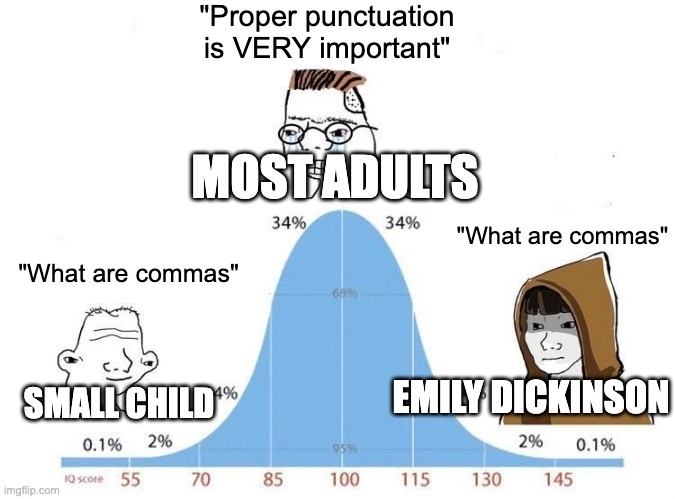
First you master your scales, then you can play jazz.
But most writing instruction in the standard education pipeline just abandons us at the first threshold, so we don’t progress to anything beyond it.
I still think it’s good to learn the basics. But if you’re reading this, you’re probably well past the point of grade-school grammar. So the point now is to reconsider the indoctrination you’ve already received. And aside from the general problems of getting stranded atop Mt. Punctuation-Is-Important in the chart above, the world around us has changed.
Writing in the Post-Information Age
In the last 4 years, getting fixated on writing form alone has gone from “Probably not a good idea” to “Complete foolishness.”
As I’ve said before, the rules for the Post-Information Age are fundamentally different:
“While social media allowed for more rapid distribution of ideas, the final straw that has pushed us over the edge is the arrival and mainstream distribution of Generative Artificial Intelligence. While computers and the Internet allowed for massive content creation, A.I. tools like ChatGPT make it possible to create an entire new book with the press of a button.
This is the point of complete information saturation. As of today, any single person with an Internet connection and access to one of these A.I. models can easily create more content in an hour than you or I could read in a day. It will only get worse.”
Not only is there more content being generated than anyone can possibly read… it’s all polished! It all looks and sounds pretty good, at least in terms of the punctuation and capitalization.
So a lot of us are still writing like it’s the Information Age or even before: Where highly polished writing is paramount. But now I hope it’s blatantly, obviously true that this is not the point. It never was, but now I hope it’s undeniable.
Write to be different
If functional writing is about sharing your perspective and thinking, expressive writing is about sharing your heart and story. But in both cases, the operative word is your.
This is what you want: For people to understand your perspective or agree with (or at least hear) your ideas.
This is also what your readers want: People who know you and care about you want to hear from you. And even internet strangers! If they’re scrolling around on social media and see the link, they’re clicking into it because they want to see something fresh and different. They want something interesting (and interesting means surprise).
Don’t just take my word for it. Here’s my favorite way I’ve seen this explained:
“My wife is a professional book editor and is looking sadder every day, because a mounting percentage of the jobs being submitted to her say this, “My book is my voice, I just ran it through AI for grammar.”
“What they don’t know,” she tells me privately “is that every one of these books sound exactly the same, even across varying subjects. They don’t know what AI is doing to the voice they think they have.”
If you read a lot of work on Substack you can see it creeping in everywhere. Authors I’ve been subscribed to for years are making the decision to “get a little help” from AI, polish things up a bit, speed up the process, and you can see it and feel it. The tells are subtle until they’re not. And then you just get sad about what is happening.
In the individual case of each writer, I’m sure it feels like an improvement. En masse it is the enshittification of communication.
Every time any author gives up a corner of their authentic voice to the help of AI, it’s like losing another species of insect or amphibian in the rainforest. A tragedy no one is tracking or shrugs away as just part of life in the modern world.
Even if the AI help has sharpened the point being made, it’s not why I read. I’m reading because it’s you, and watching you fight for hard-earned clarity and a voice that is truly yours and get there over time is the thrill of this whole communication game.”
(from Rick Lewis, in this amazing Substack note)
If this voice dilution is happening to professional authors who are editing their drafts, how much more will your voice be lost if you're completely generating large chunks or whole articles?
Your still-in-progress writing is not perfect. But having an LLM generate something for you … actually won’t be perfect either. But even more than that, it won’t be yours. It will look and sound like the mash-up of the billions of writing samples that it is.
If you’re going to write something that is indistinguishable from everyone else… what’s the point?
The best part is the scary part
Let’s cut to the core, here. I don’t think most of us really get why it’s so tempting to generate long-form posts, instead of writing them.
→ Level 1: It’s faster.
Sure, yes, correct. Probably 10x quicker, if not more.
→ Level 2: It’s easier.
This is more honest! One reason to skip writing is that it’s frustrating and kind of painful.
→ Level 3: It’s safer.
This is the part that I’m only now coming to see, myself: When I say “Great writing is about your unique perspective” … that can actually be the whole problem.
Because to sincerely share what you think or believe or see is frightening. To put your precious time and effort into some words and put them out there with the possibility that they’ll be rejected or ignored is brutal. Using AI to generate a long-form piece of writing for us provides psychological safety: If other people hate it or don’t care, then, well, it was just slop anyway, right?
Messily alive
So, yeah, I get it. I don’t blame anyone for generating things, but I just hope you know that it’s not what your readers are looking for.
To put on my marketing-guy hat for a minute: You see this in the trends in how marketing campaigns work, now: People aren't as interested in polished ads. We're more influenced by a video of some random person talking to their phone in selfie mode, vs. the scripted 30-second spots that survived 7 levels of corporate approval. There’s a lot more interest in raw, authentic video that hasn't had all the flaws buffed out. This commercial truth reflects our broader desire for human connection, as a society. Whether they know it or not, that's what readers want from your writing.
And just to be clear: I do want you to get better at writing. Messy is better than sloppy, but it's not the ideal end-state. Poorly written articles aren’t amazing, just because they’re 100% human-written. But they're better than well-written LLM generations. And you’ll never improve your writing by generating it, just like having a robot lift weights for you won’t make you stronger.
If you’re still locked up and can’t imagine putting something unfinished out there, let me recommend three things:
- Remember that you can’t lose both ways: If you decide to publish your writing online, the most likely outcome (for better and for worse)… is that almost no one sees it.
“Either you get attention and the criticism that may come with it. Or no one really notices and you can write without fear.
You can hear silence or the crowd booing, but not both.”
- Writing in private is a good thing, too. If you’ve got something you want to write out but don’t think is ready for prime-time… put it on a mostly-secret blog (like this one)! Or even just put it in a Google Doc. Send it to some friends and see what they say. That’s likely to be more meaningful and helpful than hopping onto Substack and swinging for the fences with the first essay you've written since you graduated.
- Shorter is better. Another unfortunate carry-over from our education system is the idea that a longer essay is more credible. Minimum word lengths, amirite!? But that's not how the real world works. If the part of your essay that you like is short... just publish that part! Don't you dare use generated filler just to pad the length. That's making it twice as bad.
I’d rather get a brain-dump of unstructured thoughts that are 100% you, vs. a robo-generated slop sandwich. If you text me a private draft as a link, I feel honored. And if it's short, I'm even more likely to read it.
I keep coming back to the way Micah Nathan, a writing professor at MIT, described his experience of talking about this with his students:
“The [AI-generated] stories and essays are simulacra of thought, generated via pattern recognition learned from millions of human-penned words, rooted in no particular experience by no particular person. AI writing reminds me of Tennyson’s description of the beautiful Maud in the titular poem:Faultily faultless, icily regular, splendidly null
Dead perfection, no more
Insightful readers feel that emptiness even if they can’t articulate it. They sense that the body moves without a brain. By contrast, student-written fiction is gloriously flawed, a struggle on the page between what the author is trying to say and what’s actually being said. The prose stumbles in a way reminiscent of a foal learning how to walk: even in their trembling legs I see hints of future grace. Such clumsiness is necessary; its absence would be proof of the foal never having learned to walk.”
Writing is an opportunity to share the distinct perspective of your unique and messy life. Even if it's scary, that's the whole point. You can do it. Don’t settle for dead perfection.
(Plus: The slop side is actually worse than you realize. That’s what I’ll talk about for the next post in this series: Generated essays are poison.)