Truth in Etymology

Understanding the origin of words is a secret superpower.
Looking through the lens of etymology gives you x-ray vision to see all kinds of insights, hidden in the words we use every day. Like a parallel track to dictionary-based definitions, etymology gives you a clear picture of meaning by way of historical development and progression.
Wait, but what is etymology, again? Well, what a perfect opportunity to show you what I mean:
If you just google 'Etymology definition,' you get:
the study of the origin of words and the way in which their meanings have changed throughout history.
But how was this word put together? Where did it come from? The gold-standard for this kind of things is the Oxford English Dictionary (OED), but since it's not free for everyone to use, I often reference etymonline.com (which I'll call EO, even though I don't think that's standard). Here's what EO says:
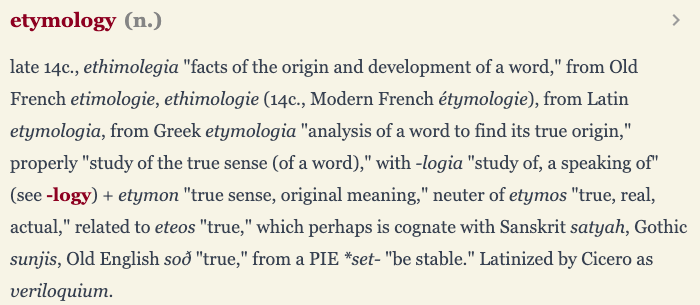
Maybe your eyes glaze over a bit with all that italicized text and references to ancient languages, so I'll just pull out the key part: the term comes from Latin and Greek, combining two words:
- Etymon → "true sense"
- Logia → "study of" (same root as biology, psychology, and most academic fields)
Cool, right? So, the point is that this is a field that, from the very beginning, has been interested in understanding what things really mean. The core idea is that, by looking at the origin of something, you can better understand it.
So, why does this matter? I see three reasons:
#1 - Meaning. "What's the meaning of life?" is probably the most famous Big Question out there, but it's always been interesting to me that no one takes it literally. Want to know the meaning of life? Well, how do you define meaning? How do you define life? We won't go down that whole rabbit trail right now, but we're all looking for meaning and the words we use play a big role. Shouldn't we know what they mean?
#2 - Verifiability. Now that we're in the post-information age, it can be harder than ever to determine what's worth trusting. Language is how humans connect with and trust each other, and as we get pushed apart by partisan politics and sensational online interactions, we can all use some common ground. So, yes, sometimes the meanings of words change, but having a built-in mechanism to check the history is helpful.
#3 - Connections. Probably my favorite part of etymology is seeing the hidden, interconnected network of meaning across our shared language. Once you realize that every word is built from component parts, you can ask... well, what other words have those parts been used to build? If you're professionally (or personally!) interested in how things connect, etymology is a cheat code.
But as with anything this abstract, it's hard to know what I'm talking about without seeing it for yourself. So, let's look at 3 examples that are particularly relevant to all of us, right now: Intelligence, Truth, and Curation.
Intelligence
We've all been fascinated with intelligence for a long time, but the arrival of the Artificial variety has made the term the center of conversation across the world. Here's the Google Trend line for the past 15 years:
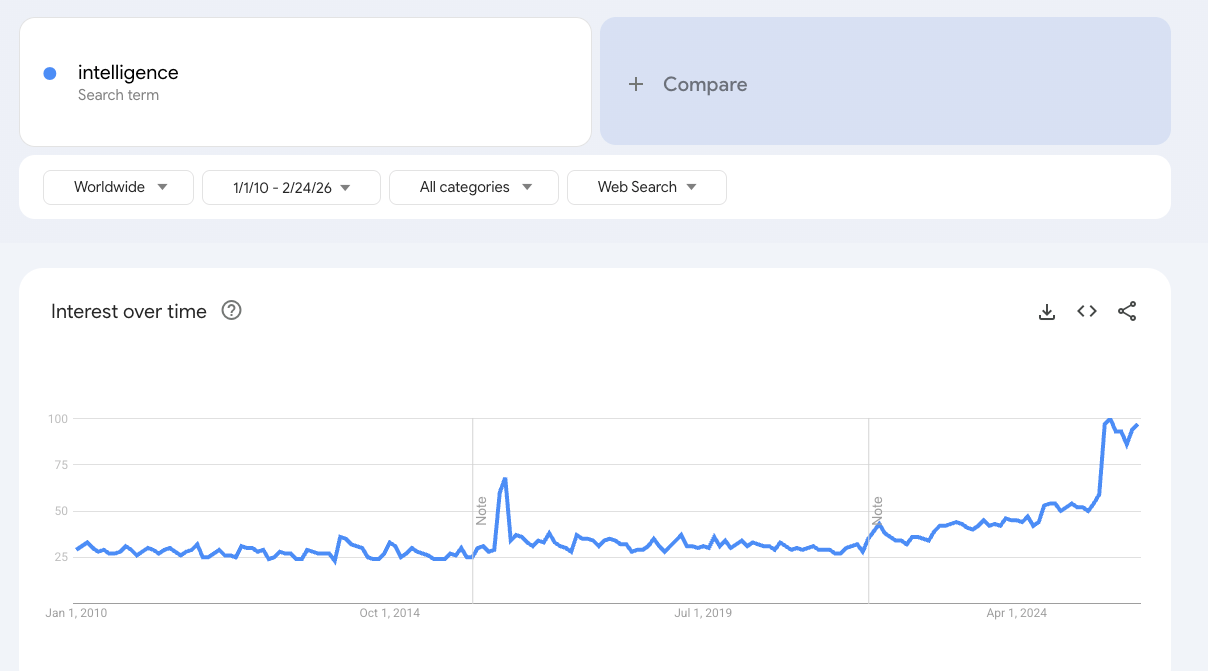
And as the world wrestles with what AI will mean for our lives and jobs, it's a perfect time to consider... what does this term even mean?
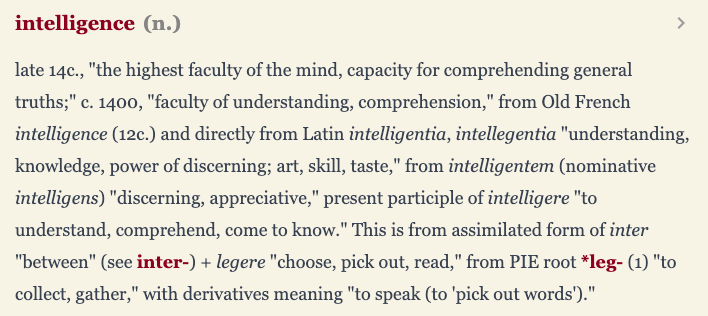
Again, just to pick out the important part:
- Inter → "between"
- Legere → "To choose"
This is a perfect example of the value of etymology. Because, if you're like me, you probably would have defined the term as something like "smartness." And admittedly, that's what the "highest faculty of the mind" definition at the top hints at. But the current Google-based definition takes that direction even farther:
"the ability to acquire and apply knowledge and skills."
So, even though most of us may use the term in that sense, isn't it fascinating to look at the distinction in defining this key term?
"ability get knowledge/skills" vs. "ability to choose"
I found this distinction so compelling that I named a whole newsletter after it: The Age of Intelligence. And while I have a feeling the nuance of that title will be lost on most, the point is that for us as humans, the rise of Artificial Intelligence creates even greater demand for classical, traditional intelligence: The ability to choose. AI is great at getting knowledge/skills, but not so much at choosing.
Now, let me show you what I mean by etymology revealing hidden connections: I think that "Legere" root word has become my new favorite. Because it's also the root for:
- Lesson - something chosen to be learned
- Collect - chosen/gathered together
- Select - chosen apart
- Elect - choose out
- Elegant - choose with care
- Neglect - not choosing
Wild, right? Seeing that choice is at the root of all of these key concepts has made me reframe how I approach them.
Truth
This one is right there in the title of this post. And it's another concept that's so big that it's unmanageable. Besides your philosophy-obsessed pal, who wants to take a shot at casually defining truth? But assuming that we do... Here's what the Google search says:
the quality or state of being true.
Ugh, not helpful. Fortunately, the secondary definition tells you what you'd get, if you looked up "true":
that which is true or in accordance with fact or reality.
"Accordance" isn't exactly a word we'd use every day, but the idea is pretty clear.
So, what does EO say?
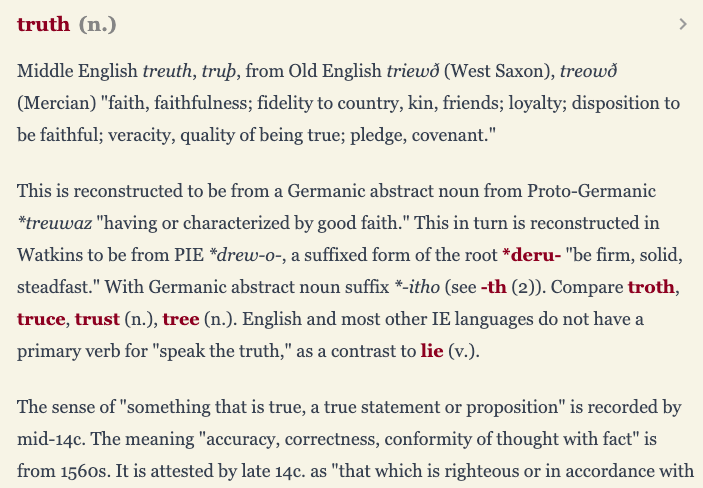
Did you catch that? The original source of 'truth' was relational. It's rooted in the idea of 'faithfulness.' It came from the same root as truce or trust.
So, what's the difference? Well, once again, in the context of how much things are changing right now, it's worth noting the difference between the more modern objective basis of truth (seeing how something matches other facts) and the historical subjective basis of truth (determining whether the source of the information was trustworthy).
Practically, I think this hints at something Kevin Kelly has pointed out—that the deterioration of digital trustworthiness will make our conversations smaller and more localized. And not necessarily in a bad way. Here's how Kevin put it:
“We will come to see that our default of 'trust first and check later' was only a short temporary anomaly in our long history. We are back to the state we have been in for most of our time as humans, where we 'check first and trust later.'”
And as for connections, the big one for me was the concept of fidelity. Yeah, it sounds like an old-timey virtue related to marriage... but it's also a technical term for describing accuracy, particularly when it comes to sound: High fidelity, or hi-fi. I wasn't expecting this link-up between an abstract relational term and a concrete technical term.
Curation
This one is a bit different. "Intelligence" and "Truth" are such common terms that we understand them intuitively and have a hard time explaining them. Curation is not as obvious. I believe it's one of the most important skills in the world—and only becoming more important—but what does it mean?
Here's Google:
"the action or process of selecting, organizing, and looking after the items in a collection or exhibition."
And here's EO:
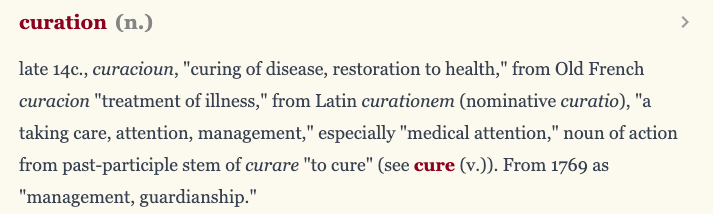
So, in this case, it's not so much that the definitions are different... but that the source provides greater depth. Curation has a lot of overlap with the process of healing. And they both have a shared root in the original meaning: To care. So, for me, this helped to shift a skill that has felt necessary but stuffy into a form of generosity.
And as for connection... isn't it interesting that curation has the same root as curious? When you think about it, yes, the reason someone wants to ask a lot of questions... is because they care.
Dig for the roots
In trying to wrap my own head around it, I've been trying to think of the right metaphor. Analogy is often the key to understanding something like this. But as is often the case with etymology, the connection is right there: Truth is in the roots.
All of these 'root words' are called that for a reason—like underground tendrils, this linguistic history goes way deeper than we realize and connects everything underneath our feet, even when we don't notice it. They grow slowly and gradually, which is exactly why we can trace them and build on them.
So, if you're curious (if you care), if you want to be trustworthy (be high-fidelity), or intelligent (be discerning)... try it for yourself.
What's a concept you've been trying to understand?
What's a connection you've been trying to make?
Once you start this approach, it's hard to stop. Once you've had one 'ah-ha' moment by looking at a word's etymology, you'll want to check everything. And the realization that everything we say has these shared, interconnected roots is ... incredible (not + believable). Overwhelming (completely + cover). Delightful (same as delicious... to lure away!).
The fun never stops! Pull up the OED or etymonline.com and see what you can find.
![[WIP] Analogy is the key](https://images.unsplash.com/photo-1503792243040-7ce7f5f06085?crop=entropy&cs=tinysrgb&fit=max&fm=jpg&ixid=M3wxMTc3M3wwfDF8c2VhcmNofDZ8fGtleXxlbnwwfHx8fDE3Njg1MDYwOTR8MA&ixlib=rb-4.1.0&q=80&w=750)